46% of all Google searches are made with local intent, but most franchise locations don’t show up in search results. Why? Because franchise SEO needs to support both national brand messaging and local rankings across dozens or even hundreds of locations.
It’s no wonder franchise businesses haven’t unlocked the potential of their online visibility. Did you know that increasing your Yelp rating by just one star increases revenue between 5-9%? With 93% of consumers reading online reviews before making a purchase, local SEO is important.
We’ll walk you through a step-by-step framework to dominate local search for every franchise location you operate.
Table of Contents
- Understanding Franchise SEO and Why It Matters
- Step 1: Build Your Foundation with Website Structure and Google Business Profiles
- Step 2: Create Location-Specific Content That Ranks
- Step 3: Master Local Citations, Reviews, and Reputation Management
- Step 4: Build Authority Through Links and Ongoing Optimization
- Conclusion
- References
Understanding Franchise SEO and Why It Matters
What Makes Franchise SEO Different from Regular SEO
SEO for Franchise Businesses may have two levels of operation at minimum; a national level for the brand overall and individual locations for each branch. This is fundamentally different than typical local SEO for franchises should be done by single-location businesses who target one geographical area.
Businesses with multiple locations must serve both the needs of the franchise brand as a whole by increasing visibility while optimizing each location to rank well within its targeted market simultaneously. This can cause conflict between appearing to be a solid brand versus providing the hyper-local content that search engines are rewarding.
On one hand, if you focus too much on national level franchise SEO marketing you risk losing touch with local markets. On the other hand, focusing too much on each location’s individual needs can cause your brand to lose strength.
The structural complexity alone presents obstacles that single-location businesses never encounter. Franchises manage multiple Google Business Profiles and coordinate between corporate marketing teams and franchisees with varying levels of digital sophistication. They must maintain NAP (Name, Address, Phone number) consistency across hundreds of citations. Search engines must treat each location as an independent entity, yet it needs to remain aligned with corporate standards.
The Dual Challenge: National Brand + Local Visibility
The greatest tension in franchise SEO services lies in balancing the franchisor’s need for consistent brand control against the franchisee’s need for local community connection. A rigid, top-down strategy often results in a generic presence that fails to appeal to local customers. Giving franchisees total freedom can cause brand dilution and off-message communication.
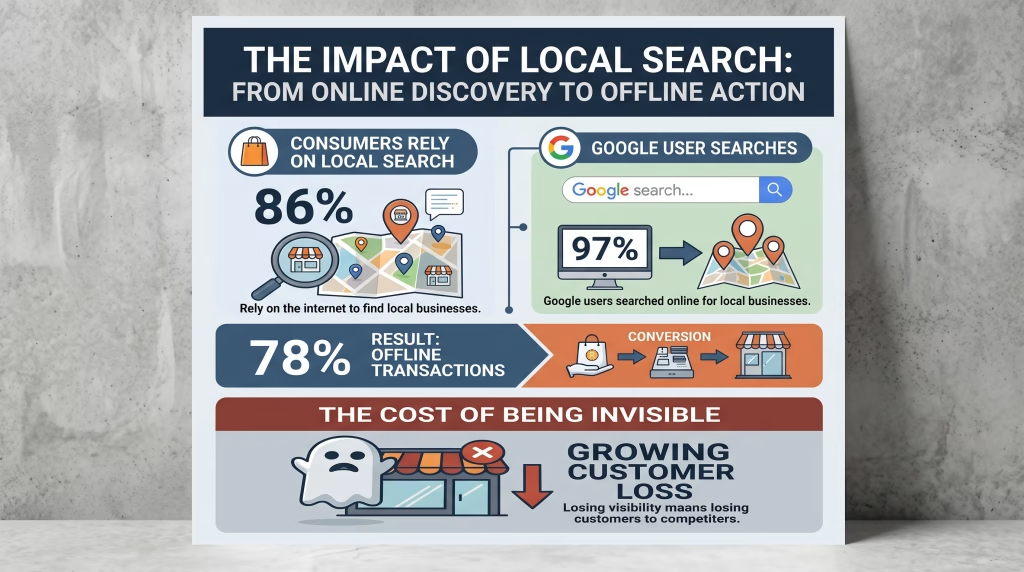
Statistics underscore why this balance matters. 86% of consumers rely on the internet to find local businesses. Google estimates that 97% of its users searched online to find local businesses. 78% of those local searches resulted in offline transactions. Missing out on local search visibility means losing a growing percentage of potential customers to competitors who have invested in their local presence.
A strong multi-location strategy helps franchises establish a dominant market position and deter competition. Franchises can increase brand visibility and reach a broader customer base by expanding their presence to multiple locations. They capture a larger market share. But this only works when both national and local SEO elements work together rather than against each other.
Why Most Franchise Locations Stay Invisible in Search
Corporate websites are not friendly for local search. Many franchises run off one corporate domain with a locations directory. However these location pages are usually thin, duplicate and template pages. Google basically sees these as almost identical pages when you have 50 pages copying and pasting the same copy, layout and images with just their address changed. Duplicate content rarely ranks.
Search engines identify templated location pages where only the address and phone number change. This practice creates thin or duplicate content that search engines devalue because it offers a poor user experience. Your own locations either compete against each other for rankings or fail to rank at all. The result? Invisibility in local search.
So when location pages don’t rank organically, franchisees turn to paid advertising. But Google PPC costs have risen up to 20% year over year in many industries[8]. Local service keywords in major metro areas now exceed $20.00-$40.00 per click[8]. SEO lowers customer acquisition costs when it works properly. When it doesn’t, franchises have no choice but to overspend on advertising.
Territory overlap creates another problem specific to SEO for franchise websites. Two franchisees in adjacent markets compete for the same searches and split signals that should have been concentrated on one location. Some franchisees create their own listings and pages without informing corporate. This produces duplicate Google Business Profiles and conflicting NAP data that undermine the entire network.
Step 1: Build Your Foundation with Website Structure and Google Business Profiles
Choosing Between Single Domain vs Multiple Sites
Individual websites for each location fragment authority and result in cannibalization. By having more than one site competing for the same services and keywords you lose out on consolidating strength. With subdirectories (yourfranchise.com/location), you get the best of both worlds: consolidated authority with separate locales.
With subdirectories each location leverages ranking power from the domain homepage. When one location gets a backlink, they all get a backlink. Separate domains mean starting from zero every time. You pay more for hosting, domain names, and site maintenance. With subdirectories you only need one set of analytics to monitor all locations.
Search engines view subdirectories as part of the main website while treating subdomains as separate entities. This difference matters because content on subdomains doesn’t contribute to main domain rankings. Subdirectories concentrate keyword relevance onto a single domain and build trust faster with search engines. They perform better in AI-driven search systems that prioritize clear business identity.
Setting Up Google Business Profile for Each Location
Each physical location requires its own verified Google Business Profile. Businesses with full profiles are 2.7 times more likely to be thought trustworthy by customers. Geographic-specific search results surface businesses with verified profiles in that area. A single headquarters listing provides no coverage for other service areas.
Bulk verification eliminates manual postcard verification for each new addition for franchises with 10 or more locations[1]. Access Business Profile Manager and create business groups to organize locations. Submit bulk verification requests through Google’s form process[1]. Business groups allow collective management and applying changes across multiple profiles at once[2].
Enter business names as they appear across all locations. Keep categories the same while using unique addresses to prevent Google from flagging duplicate listings. Complete every profile section including hours, services, photos and descriptions. Incomplete profiles rank lower than full ones.
Ensuring NAP Consistency Across All Platforms
NAP consistency functions as a trust signal. Search engines cross-reference business information against directories, websites and structured data. Conflicts weaken local ranking signals. 73% of users lose trust in brands with inaccurate business listing data.
Create a master spreadsheet documenting exact NAP format for each location. This becomes the reference standard for every platform update. Address variations like “Street” versus “St” create ambiguity, though search engines understand minor formatting differences when core information remains accurate.
Focus on corrections first on high-authority platforms: Google Business Profile, your website and major directories. Use citation management tools to monitor and update listings at scale across hundreds of directories at once.
Implementing LocalBusiness Schema Markup
LocalBusiness schema provides search engines with explicit structured data about each location. Include the specific business type (Restaurant, HomeAndConstructionBusiness, MedicalBusiness) and complete PostalAddress with street, city, region and postal code. Add geographic coordinates with five decimal place precision, telephone number with country code and opening hours in OpeningHoursSpecification format[3].
Establish parent organization schema on the homepage using Organization type for multiple locations. Each location page receives LocalBusiness schema with parentOrganization property referencing the main brand entity. This hierarchy clarifies relationships between corporate brand and individual branches for search engines.
Validate markup using Google’s Rich Results Test before deployment. Schema errors cause search engines to ignore the data. Regular validation keeps accuracy as business details change during holiday hours or service updates.
Step 2: Create Location-Specific Content That Ranks
Building Unique Landing Pages for Each Franchise
Google records 1.6 billion local searches every day. Each location page must deliver enough substance to compete for that traffic. You want 600 to 900 words of unique, localized copy per page. This isn’t arbitrary. Search engines use a quality threshold when deciding which pages deserve indexing and visibility.
Start with content elements that prove authenticity. Real photos of the actual storefront, interior and local team build trust. Stock imagery doesn’t come close. Embed customer reviews specific to that branch and include names and quotes that reference the location. Add a FAQ section addressing questions unique to that area: parking availability, public transit routes, regional pricing differences or service radius boundaries. These elements increase your chances of appearing in featured snippets and AI-generated results.
Title tags should follow a simple formula: primary service plus city plus differentiator. Meta descriptions must include the “what” and “where” with a reason to click, whether that’s pricing, availability or social proof. Write unique descriptions for every page. Long keyword strings trigger spam filters, so avoid them.
Using Local Keywords Without Cannibalizing Rankings
Keyword cannibalization occurs when multiple pages target similar terms and compete against each other rather than competitors. Search engines split ranking signals across your own pages as a result and weaken all of them.
Build a keyword map before creating content. Assign each location a distinct set of terms tied to its geography. Your Denver page targets “plumber in Denver” while your Aurora page focuses on “plumber in Aurora.” Never duplicate the same head term across locations with just the city name swapped in metadata.
Local keywords follow predictable patterns: service plus city, “near me” queries and neighborhood or region modifiers. Research which terms locals use. Some neighborhoods have informal names that residents search for but don’t appear on official maps.
Incorporating Neighborhood Names and Local Landmarks
Hyperlocal targeting captures searchers who specify neighborhoods, districts and landmarks rather than just cities. Mention specific streets, nearby attractions or prominent reference points throughout your content. A spa in Los Angeles might optimize for “luxury spa in Beverly Hills” or “day spa near Rodeo Drive” rather than generic city terms.
Reference local values, lifestyle characteristics and community events where relevant. Businesses seen as active community members earn both user trust and search engine relevance signals. Link to neighborhood-centric pages or case studies that provide valuable area information.
Avoiding Duplicate Content Across Locations
Template structure works fine for layout, colors, fonts and navigation. The written content, reviews and local details must be unique per location. Your Dallas page and Austin page won’t rank when they share 95% identical copy.
Divide pages into fixed and variable sections. About half can feature consistent brand information and service standards. The remaining half must contain dynamic local data: live review feeds, hours in real time, team names and location-specific FAQs. This approach gets you unique pages at scale without writing every word from scratch.
Step 3: Master Local Citations, Reviews, and Reputation Management
Listing Your Franchises on Key Directories
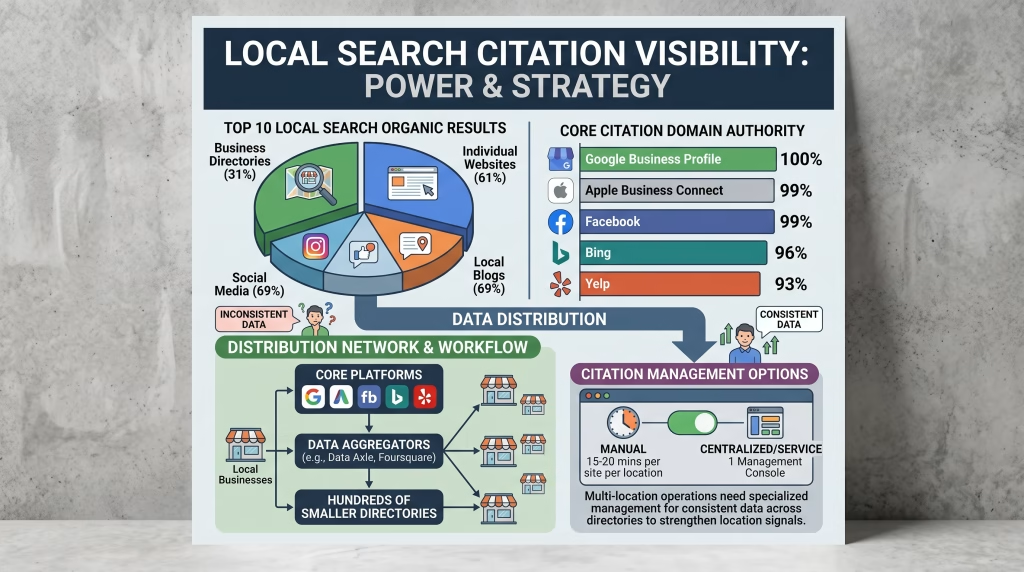
Business directories account for 31% of top 10 organic results in local search[4]. Google Business Profile remains the most powerful citation with a domain authority of 100. Apple Business Connect (99), Facebook (99), Bing (96), and Yelp (93) follow close behind[4]. These platforms feed location data to hundreds of smaller directories through data aggregators like Data Axle and Foursquare.
Submit each location to core platforms first. Then expand to industry-specific directories. Citations reinforce location signals that Google uses for ranking. Inconsistent data across directories creates conflicting signals and weakens visibility. Citation building takes 15-20 minutes per site when done manually[4]. Multi-location operations need centralized management or specialized services to handle this work.
Getting and Responding to Customer Reviews
Customer response expectations have intensified. 88% of consumers will choose a business that responds to every review. Only 47% would choose one that never replies. Brands responding within four hours convert more situations into recovered relationships.
Address negative reviews without admitting fault before you gather facts. Apologize for the experience itself and take conversations offline with direct contact information. Document outcomes. Skip generic “thank you” responses for positive reviews. Reference specific services or experiences the reviewer mentioned. This demonstrates genuine engagement[5].
Managing Your Online Reputation at Scale
Centralized review management ensures consistent brand voice and professionalism in responses. Provides valuable data insights across markets. The corporate team should own the tooling and define the response framework. Corporate manages legal escalations and brand-level performance reporting. The local team drafts responses and owns offline recovery, keeping the relationship with the customer.
Define response time expectations, particularly for negative reviews. Response time and review velocity should be tracked as leading indicators within your franchisees’ control.
Encouraging Review Generation Systems
Identify the natural moment when customers are most likely to leave positive reviews. Send direct review links via text message right after that trigger point. Text messages have open rates above 90%. Emails sit in inboxes.
Automate one follow-up reminder 24-48 hours later for customers who agreed but didn’t complete the review. Train teams on simple scripts that feel natural rather than forced. Automation should request reviews consistently but never offer incentives. This violates Google’s terms[6].
Step 4: Build Authority Through Links and Ongoing Optimization
Local Link Building Strategies for Each Location
Link building for franchises prioritizes relevance over raw volume. A handful of strong local links outperform large quantities of generic ones. Focus on sources that reinforce each location’s geographic presence: local news sites, regional publications, nearby business partners and community organizations.
Local media carries substantial weight, especially when you have coverage tied to newsworthy activities. Partnerships with suppliers or complementary businesses generate natural link opportunities when relationships already exist. Citations from trusted local directories support consistency while providing link signals.
Sponsoring Local Events and Partnerships
Sponsorships deliver dual benefits: backlinks and brand visibility. Your franchise positions itself in front of target customers while earning links from high-authority local domains when you support local sports teams, charities, schools or cultural organizations. Organizations acknowledge sponsors on dedicated pages, creating contextually relevant backlinks surrounded by community information.
Select opportunities that match brand values for cohesive narratives. Track sponsorship data and measure ROI beyond link metrics to inform future decisions.
Tracking Performance at All Franchise Locations
Location-specific dashboards break down rankings, traffic and conversions by individual branch. Citation consistency and Google Business Profile performance need monitoring to identify visibility issues that prevent local rankings. Weekly reporting prevents performance decay in unmanaged campaigns.
Core Web Vitals and Technical SEO Maintenance
Core Web Vitals measure loading performance (LCP under 2.5 seconds), responsiveness (INP under 200 milliseconds) and visual stability (CLS under 0.1)[7]. Template-level fixes scale improvements simultaneously at all location pages.
Scaling SEO Efforts with Automation Tools
Automation platforms that use AI achieve 46% better visibility in AI-powered search results. Automated systems handle citation building, NAP consistency monitoring, review responses and rank tracking. This saves 40+ hours weekly.
Conclusion
You now have a complete roadmap to dominate local search at every franchise location you operate. Build your foundation with proper website structure and Google Business Profiles. Create unique location pages that rank. Each step builds on the previous one.
The key to successful franchise SEO is consistency and strategic execution. Focus on implementing these steps in a systematic way rather than trying to perfect everything at once. Start with your highest-performing locations and document what works. Then scale those strategies across your network.
Note that franchise SEO is ongoing work, not a one-time project. Keep optimizing and monitoring your rankings. Adapt to changes. Your local visibility will compound over time.
References
[1] – https://www.brightlocal.com/learn/verifying-google-business-profile-for-multiple-locations/
[2] – https://support.google.com/business/answer/7655842?hl=en
[3] – https://developers.google.com/search/docs/appearance/structured-data/local-business
[4] – https://www.brightlocal.com/resources/top-citation-sites/general/top-50/
[5] – https://www.business.com/articles/respond-to-all-your-online-reviews/
[6] – https://support.google.com/business/answer/3474122?hl=en
[7] – https://developers.google.com/search/docs/appearance/core-web-vitals
[8] – https://www.entrepreneur.com/franchises/the-seo-framework-i-used-to-scale-70-franchise-locations/499669
Ready to Dominate Local Search in the RGV?
We build high-performance websites with built-in semantic structure and local entity schemas. Let's make your business the authority in South Texas.

Written by Carlos Guzmán
Carlos Guzmán is the founder of RGV Web — a web designer and SEO specialist with 20+ years of experience helping small businesses in Mexico and the U.S. turn their websites into real business assets, from design and development to SEO, automation, and e-commerce.