On August 28, 2026, Google confirmed to Search Engine Land that AI Overviews now dynamically expand to their full answer on some searches — no click on “Show more” required. That sounds like a small UI tweak. For a business competing for search traffic in a market the size of the Rio Grande Valley, it isn’t. Every extra inch an AI-generated answer takes up on the results page is an inch your listing, and your competitor’s, gets pushed further down.
I run a web design and SEO practice here in McAllen, and this is the kind of change I watch closely — not because it’s dramatic, but because it’s exactly the sort of quiet update that changes what “ranking #1” is actually worth. Here’s what changed, what the data says about it, and what an RGV business should actually do about it.
Table of Contents
- Do bigger AI Overviews mean less traffic to my website?
- What actually changed on August 28
- Why this hits harder in a market the size of the RGV
- The real numbers behind the worry — and the silver lining
- How to actually measure this on your own site
- Why being “the best source” matters more than it used to
- What we’re doing about it — and what you should too
- Quick FAQ
- Want help making your site the source Google cites?
Do bigger AI Overviews mean less traffic to my website?
Sometimes, yes. When a full AI Overview appears above the results, click-through on the top organic result can drop by roughly half. But the same research shows businesses whose content actually gets cited inside that AI Overview see meaningfully more clicks per impression than competitors who rank but aren’t cited. The risk isn’t that AI Overviews exist — it’s not being the source they pull from.
What actually changed on August 28
Until now, a full AI Overview usually required a click on “Show more” to expand past a short summary — meaning at least some of the page still showed standard organic results above the fold. Google told Search Engine Land that’s no longer always true:
“For some queries, AI Overviews may dynamically expand for topics where our systems determine it’s most useful for people.”
Google spokesperson, quoted in Search Engine Land, Aug 28, 2026
That’s the entire confirmation. No percentage of queries, no list of categories, no Search Central blog post or help-doc update to go with it — just an on-record statement to a reporter. So treat the scope honestly: this is confirmed to be happening on some queries, not a documented rollout with defined rules. What’s confirmed is the mechanism — a bigger AI answer, rendered automatically, sitting above the traditional blue links.
Why this hits harder in a market the size of the RGV
A national retailer competing for a keyword with tens of thousands of monthly searches can absorb an organic traffic dip and still have volume left over. Most of the money-page queries an RGV business actually competes for — “web design McAllen,” “AC repair McAllen,” “family dentist Edinburg” — sit in the low hundreds of searches a month, not the tens of thousands. When an AI Overview is already taking a bigger bite out of a smaller pie, the percentage swing for a local business is bigger, not smaller, than it would be for a national brand.
It also compounds with something else already reshaping local results: Google’s own local-search analysts logged in August that AI Overviews answering local queries have been pulling from low-quality listicle sites rather than the actual businesses being discussed (Sterling Sky, Aug 12, 2026). In a small market, that means a thin third-party directory page can end up representing your business inside an AI answer better than your own website does — not because it’s more accurate, but because it’s structured in a way that’s easier for an AI system to extract and cite.
The real numbers behind the worry — and the silver lining
Two data points, from two different studies, tell the more complete story:
- Click-through on the #1 organic result drops by roughly 58% when an AI Overview appears on that search, per Ahrefs data reported in Search Engine Journal.
- Brands actually cited inside an AI Overview see about 120% more organic clicks per impression than competitors who rank on the same query but aren’t cited, per Seer Interactive’s 2026 research, also reported by Search Engine Journal.
Read together, those two numbers say the same thing from opposite directions: the traffic didn’t disappear, it moved. It moved toward whichever business the AI Overview decided to name. That’s a fight over being the cited source, not a fight against AI Overviews existing in the first place.
How to actually measure this on your own site
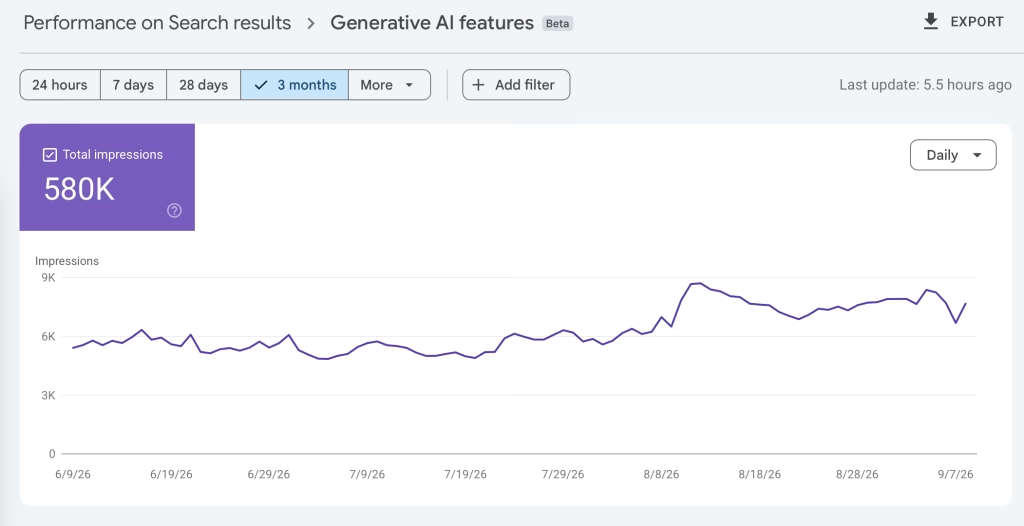
The tool that used to make this argument mostly theoretical just changed. Google’s Search Console “Generative AI” performance report — which shows impressions from AI Overviews, AI Mode, and Discover in one place — finished rolling out worldwide on August 31, 2026, alongside a new opt-out control (Search Engine Land; Search Engine Journal). If your Search Console account is connected, you can now see, in some form, whether your pages are showing up in AI-generated answers at all.
“In some form” is doing real work in that sentence, though. Here’s exactly what the report can and can’t tell you today:
| The AI performance report can show | It cannot (yet) show |
|---|---|
| Impressions across AI Overviews, AI Mode, and Discover | Clicks generated from those surfaces |
| Which queries triggered an AI-surface appearance | Click-through rate |
| Trend over time | Your position within the AI-generated answer |
| — | Revenue or lead attribution |
That gap matters. An impression tells you Google’s AI systems noticed your page exists for a given query — it doesn’t tell you whether that translated into a visit, a call, or a sale. Anyone using this report to claim precise ROI from “AI search” is overstating what the data actually supports right now.
One more thing worth flagging directly: the same update introduced a “Search generative AI control” toggle in Settings. It’s off by default, meaning your pages stay eligible to appear in AI Overviews, AI Mode, and Discover unless you deliberately turn it on. Turning it on excludes your site from those surfaces specifically — it does not change your normal blue-link rankings either way. For almost every small business in the RGV, there’s no upside to flipping that switch. It only takes away a source of free visibility you’d otherwise get by default.
Why being “the best source” matters more than it used to
Circling back to the Sterling Sky finding above: if Google’s AI systems are already citing thin listicle pages for local queries, the bar to become the cited source isn’t “outrank everyone” — it’s “answer the question more clearly, on your own page, than whatever Google is currently grabbing instead.” That’s a genuinely winnable position for a small, well-run local site, and it’s a different skill than traditional keyword-stuffed SEO. It rewards a page that states a direct answer near the top in plain language, backs it with specifics, and doesn’t bury the useful part under three paragraphs of introduction.
What we’re doing about it — and what you should too
We’re connecting Google Search Console on rgvweb.net this month specifically to start capturing this report from day one. It’s not live yet, so I’m not going to hand you numbers I don’t have — but once we’ve got 30 days of real data on our own site, we’ll publish it, good or bad, instead of theorizing about it.
In the meantime, here’s the actual checklist, in order of effort:
- Connect Search Console if you haven’t already. You cannot see any of this without it. If you’re not sure whether yours is set up correctly, that’s part of what we check first with any new client.
- Check the opt-out toggle in Settings once you’re connected. Confirm it’s off. An accidentally-checked box is a one-click way to lose AI-surface visibility you were never trying to give up.
- Rewrite your most important page’s opening so it answers the single question a customer is actually asking, in the first two or three sentences, before anything else. That’s the paragraph an AI system is most likely to lift.
- Don’t panic-rebuild your whole site. This is one confirmed behavior on “some queries,” not a documented algorithm overhaul. Measure first.
If paid search is part of your mix too, the same logic about disappearing above-the-fold real estate applies there — it’s one more reason to look at organic and paid together rather than treating them as separate budgets. And if you want to see what “structured to be the cited source” actually looks like on a real project, our portfolio has current examples.
Quick FAQ
Will opting out of AI Overviews protect my regular Google rankings?
Your normal rankings aren’t affected either way — the control only determines whether you’re eligible to appear inside AI Overviews, AI Mode, and Discover. Opting out simply forfeits any traffic those surfaces might otherwise send you.
How widespread is the auto-expand behavior?
Unknown. Google’s only public statement, given to Search Engine Land on August 28, 2026, confirms it happens on “some queries” without specifying which ones or how many. There’s no Search Central documentation update yet — treat the scope as unconfirmed until Google publishes more.
Want help making your site the source Google cites?
RGV Web is a web design and SEO practice based in McAllen, TX, built around exactly this kind of change — the technical, structural side of showing up in AI-generated answers, not just traditional rankings. If you want a plain-language read on what this means for your specific site, start the conversation here or call (956) 991-6596.
Ready to Dominate Local Search in the RGV?
We build high-performance websites with built-in semantic structure and local entity schemas. Let's make your business the authority in South Texas.

Written by Carlos Guzmán
Carlos Guzmán is the founder of RGV Web — a web designer and SEO specialist with 20+ years of experience helping small businesses in Mexico and the U.S. turn their websites into real business assets, from design and development to SEO, automation, and e-commerce.